
What Fervo’s Project Red Says About the Direction of Geothermal
Geothermal has a simple advantage that continues to make it important in conversations about the future of energy: the Earth is always producing heat.
Accessing that heat economically and reliably is much more complicated. Conventional geothermal development has historically depended on finding locations with the right combination of heat, fluid, and permeability. Enhanced geothermal systems (EGS) are expanding the range of resources that may eventually be developed by creating engineered pathways for fluid to circulate through hot rock.
Fervo Energy recently published more than two years of production data from Project Red, its EGS pilot in Nevada. EnviTrace has no affiliation with Fervo Energy; we are highlighting the work because the publicly available results provide a useful example of the progress being made in enhanced geothermal and the technical questions that come with it.
For anyone interested in geothermal technology, the amount of operating history is particularly useful.
How enhanced geothermal works
A geothermal power system needs a way to move heat from underground to the surface.
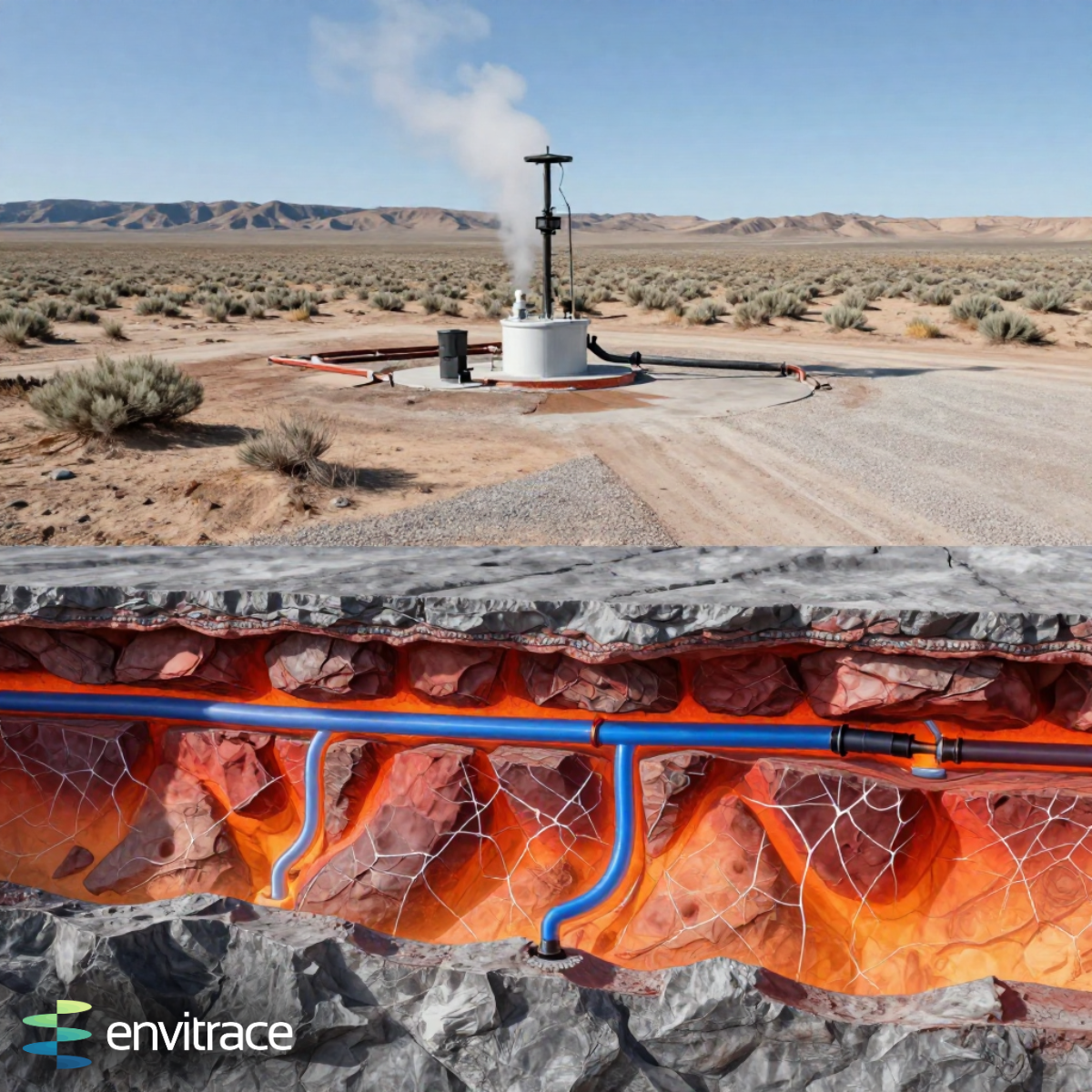
In an EGS configuration like Project Red, wells are drilled into hot rock and connected through an engineered fracture network. Water injected through one well moves through those fractures, absorbs heat from the surrounding rock, and is produced back to the surface through another well. That heat can then be converted into electricity.
Horizontal drilling and stimulation techniques allow developers to create much greater contact with the hot rock than a single vertical well could provide. Monitoring technologies are also becoming an important part of these systems. Project Red, for example, uses fiber-optic sensing, pressure and temperature sensors, well imaging, tracer testing, and other measurements to observe reservoir behavior.
All of that generates information about a part of the system that remains difficult to observe directly.
How well are the fractures connected? Where is the injected water traveling? How efficiently is heat moving from the rock into the circulating fluid? How will temperatures and pressures change after hundreds or thousands of circulation cycles? What does that tell us about well spacing and future reservoir design?
Longer operating histories help answer those questions.
Two years underground tells us much more than a short test
Project Red has now accumulated more than 614 days of production. Fervo reports an average production temperature of 347°F, average gross power output of 2.1 MW, and no downhole workovers, remediation, or chemical treatments over that operating period. Outside outages associated with surface facilities and grid infrastructure, the company reports 98.4% uptime.
The temperature data is especially interesting from a subsurface perspective.
Production temperatures remained stable for more than 500 days before a decline of approximately 2.5°F was observed. Fervo reports that the timing was consistent with its reservoir modeling. The company can now use the production history to calibrate properties such as fracture surface area, effective flow connections, and fracture spacing against observed field behavior.
This type of validation is important for geothermal development.
Reservoir models are built using incomplete knowledge of a very complicated natural system. Geology varies over short distances. Fracture networks are difficult to characterize. Fluid and heat transport interact over time. Measurements collected at a well provide valuable information, while still representing a relatively small window into a much larger volume of rock.
Operating data gives engineers and scientists another way to constrain those models and refine their understanding of the reservoir.
That knowledge carries into the next design.
The value extends beyond one EGS project
EGS could substantially increase the number of locations where geothermal energy can be developed.
Conventional geothermal resources are geographically constrained because the necessary subsurface conditions have to occur together naturally. Engineering permeability creates additional development possibilities in areas where substantial heat exists but fluid pathways are limited.
The energy implications are significant.
Geothermal power can operate continuously and provide firm generation to the grid. As electricity demand increases and the energy system incorporates larger amounts of variable generation, reliable resources that are available regardless of weather or time of day become increasingly valuable.
There are still major technical and economic questions to work through as EGS grows. Drilling costs, reservoir performance, water management, induced seismicity, long-term thermal behavior, project economics, and suitability across different geologic environments all need continued research and field experience.
Projects that publish meaningful operating data help the industry learn faster.
Better subsurface information will be part of that progress
Geothermal development increasingly draws on large combinations of geological, geophysical, geochemical, seismic, drilling, monitoring, and production data.
Making those datasets useful is its own technical challenge.
EnviTrace works in this part of the geothermal technology landscape. Our geothermal and subsurface tools use science-informed and physics-informed AI to analyze complex geologic information, characterize reservoirs, and support decisions throughout exploration and development. GeoML focuses on geologic reservoir characterization, while our geothermal research and GeoTGo work have applied machine-learning approaches to geological, geochemical, and geophysical information for geothermal resource assessment.
Induced seismicity is another area where better analysis becomes increasingly important as fluids are injected underground. EnviTrace's LAPIS work combines physics, machine learning, seismic observations, and injection data to support induced-seismicity analysis associated with subsurface activities including geothermal development.
These types of tools can support geothermal development by helping technical teams extract more information from the data they already collect, evaluate uncertainty, compare observations with expected physical behavior, and identify patterns that may warrant closer investigation.
There is substantial room for progress across the entire geothermal technology stack: drilling, completions, reservoir engineering, sensing, seismic monitoring, numerical modeling, data analysis, and AI. Improvements in one area create better information and new opportunities in others.
A useful milestone for geothermal
Fervo designed Project Red as a learning platform, including tighter well spacing and shorter laterals intended to accelerate data collection and model calibration. The company says lessons from that operating history are informing subsequent commercial designs.
That is useful for the geothermal community to see.
Field deployment produces the measurements needed to test assumptions that are difficult to resolve in the laboratory or through modeling alone. Longer production histories add information about reservoir behavior that simply is not available during a short-duration demonstration.
For geothermal, each additional dataset improves the industry's collective understanding of how engineered reservoirs behave and how they might be developed more effectively.
The potential payoff is substantial: broader access to the heat already beneath us and another source of reliable energy available around the clock.
Work that moves the industry closer to that goal is worth paying attention to.
Fervo Energy published its Project Red production analysis, “Enhanced Geothermal Has Been Proven at Scale. Here’s What Two Years of Production Data Show,” on April 13, 2026. You can read the article here: Fervo Energy’s Project Red production analysis.
About EnviTrace
EnviTrace develops AI-enabled geoscience and environmental intelligence solutions that help organizations transform complex scientific and operational data into decision-ready insight. The company combines domain science, advanced analytics, physics-informed modeling, and artificial intelligence to support applications in geothermal energy, water, environmental remediation, critical minerals, and subsurface-system management.