
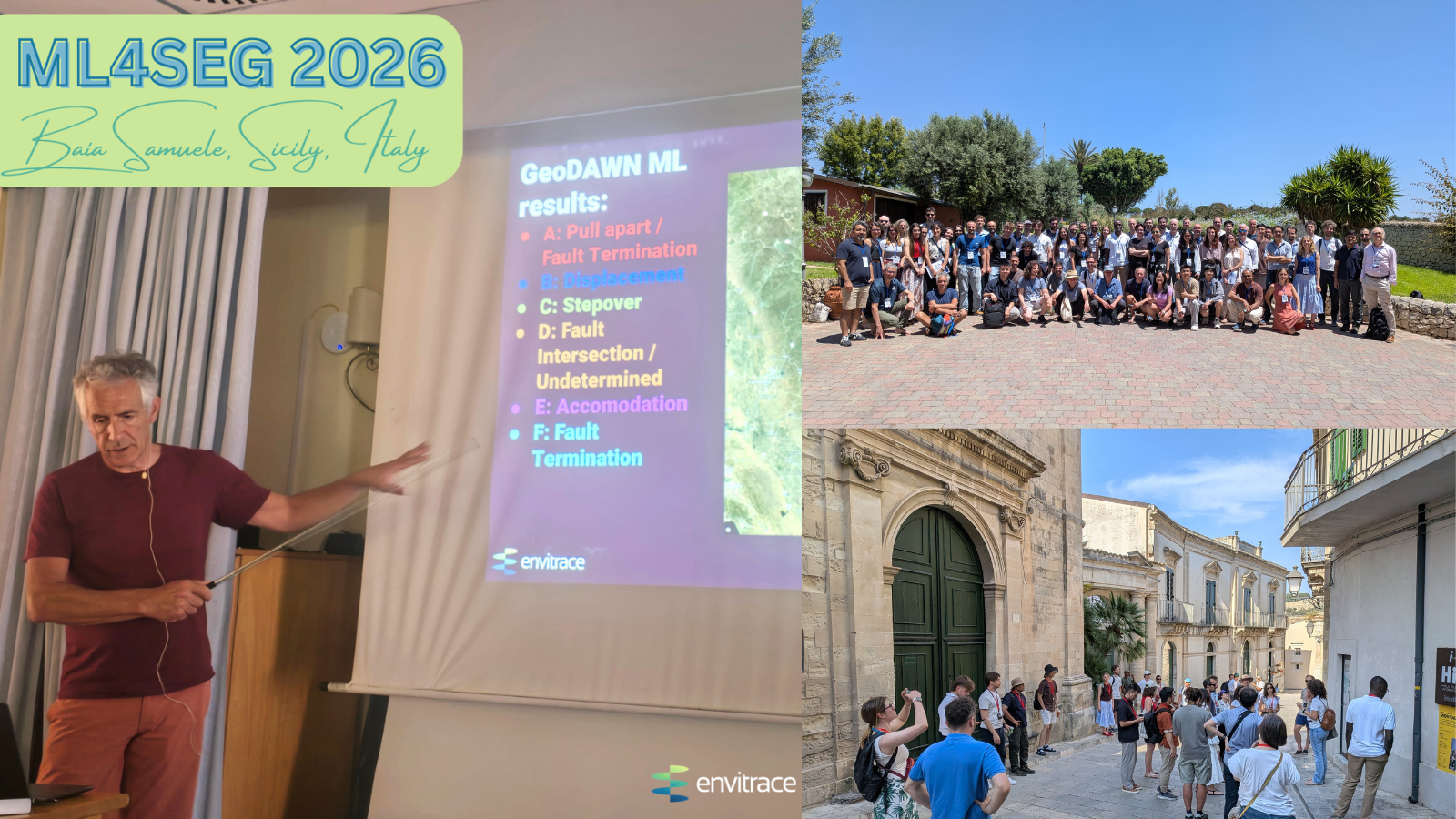
EnviTrace Presents Multimodal Geospatial AI Research at ML4SEG 2026 in Sicily, Italy
EnviTrace CTO and Co-Founder Dr. Velimir Vesselinov delivered an invited presentation at ML4SEG 2026 (Machine Learning for Solid Earth Geosciences and Earthquake Physics), an international conference focused on the application of machine learning and artificial intelligence to Earth science challenges.
Held June 14–19 in Sicily, Italy, ML4SEG brought together researchers from universities, national laboratories, and industry to discuss advances in earthquake forecasting, geothermal energy, mineral exploration, volcanic systems, and subsurface characterization.
Invited Presentation on AI for Critical Minerals and Geothermal Exploration
Dr. Vesselinov opened the conference session on Geothermal Energy, Critical Minerals & Multi-scale Subsurface AI with an invited talk titled:
"Beyond Prospectivity Maps: Multimodal Geospatial AI for Critical Mineral Systems and Geothermal Prospectivity Exploration."
The presentation explored how multimodal geospatial AI can integrate geological, geophysical, geochemical, remote sensing, and spatial datasets to improve exploration targeting and decision-making for both critical mineral resources and geothermal energy development.
As exploration programs increasingly generate large and diverse datasets, new machine learning approaches are helping geoscientists identify patterns and relationships that may not be apparent through traditional analysis alone. These methods have the potential to reduce exploration uncertainty, prioritize targets, and improve the efficiency of resource discovery.
Geothermal Energy and Critical Minerals: Growing Global Priorities
The session focused on technologies supporting two rapidly growing sectors: geothermal energy and critical minerals.
Geothermal resources are receiving increased attention as countries seek reliable, low-carbon energy sources capable of providing baseload power. At the same time, demand for critical minerals continues to grow due to their importance in energy storage, electrification, advanced manufacturing, and national security.
Machine learning, geospatial analytics, and physics-informed modeling are becoming increasingly important tools for addressing exploration challenges in both sectors.
Collaboration Across Academia, National Laboratories, and Industry
The session also included presentations from friends of EnviTrace, Dr. Daniel O'Malley and Dr. Christopher Johnson of Los Alamos National Laboratory, and was chaired by Dr. Paul Johnson.
Throughout the conference, participants shared new approaches for applying machine learning to geoscience problems ranging from earthquake forecasting and seismic analysis to geothermal resource assessment and mineral exploration.
Advancing AI for Earth and Energy Applications
At EnviTrace, we develop AI and machine learning technologies designed specifically for Earth science applications. Our work focuses on combining domain expertise in geology, geophysics, hydrology, and subsurface systems with modern computational methods to support better scientific understanding and operational decision-making.
We appreciate the opportunity to participate in ML4SEG 2026 and contribute to ongoing discussions about the future of machine learning in geoscience, geothermal energy, and critical mineral exploration.