

Albuquerque Journal Highlights EnviTrace’s RAIN Project and Water Forecasting Work
EnviTrace and our RAIN project were recently featured by the Albuquerque Journal in an article examining how artificial intelligence could help improve water forecasting across the West.
The article, written by Justin Horwath, highlights EnviTrace’s role in the U.S. Department of Energy’s Genesis Mission and the broader challenge RAIN is designed to address: understanding how surface water, groundwater, weather, soils, aquifers, reservoirs, and the surrounding subsurface interact.
That challenge is becoming increasingly important across the Southwest.
Water managers rarely have the luxury of working with one complete, perfectly aligned dataset. Instead, decisions are often informed by information coming from many different sources — satellite observations, stream gauges, weather data, snowpack measurements, groundwater wells, reservoir records, geologic information, and more.
Each dataset provides part of the picture. The harder question is determining which information matters most, how those signals interact, and how much confidence decision-makers should place in a forecast.
That is where RAIN comes in.
Building Better Insight From Complex Water Data
RAIN stands for Rigorous AI and Information Network for Surface-Subsurface Water System Coupling.
The project is focused on developing new approaches for analyzing complex environmental data and improving predictions of interconnected surface and subsurface water systems.
Rather than treating artificial intelligence as a replacement for physical understanding, the work brings AI and machine learning together with geoscience, hydrology, information theory, and physics-informed analysis.
The goal is to help researchers identify the most informative relationships within large, heterogeneous datasets and better understand how different parts of a water system influence one another.
For example, a useful water forecast may depend on some combination of precipitation, snowmelt, soil conditions, reservoir levels, groundwater behavior, and antecedent conditions. Those relationships can vary substantially from one watershed to another.
RAIN is designed to help determine which signals are most useful under different conditions while also preserving an understanding of uncertainty.
Focusing on the Colorado River Basin
During the first phase of the project, the RAIN team will focus on watershed-reservoir systems within the Colorado River Basin.
These systems will represent different hydrologic conditions, including snowmelt-dominated, mixed, and groundwater-influenced environments.
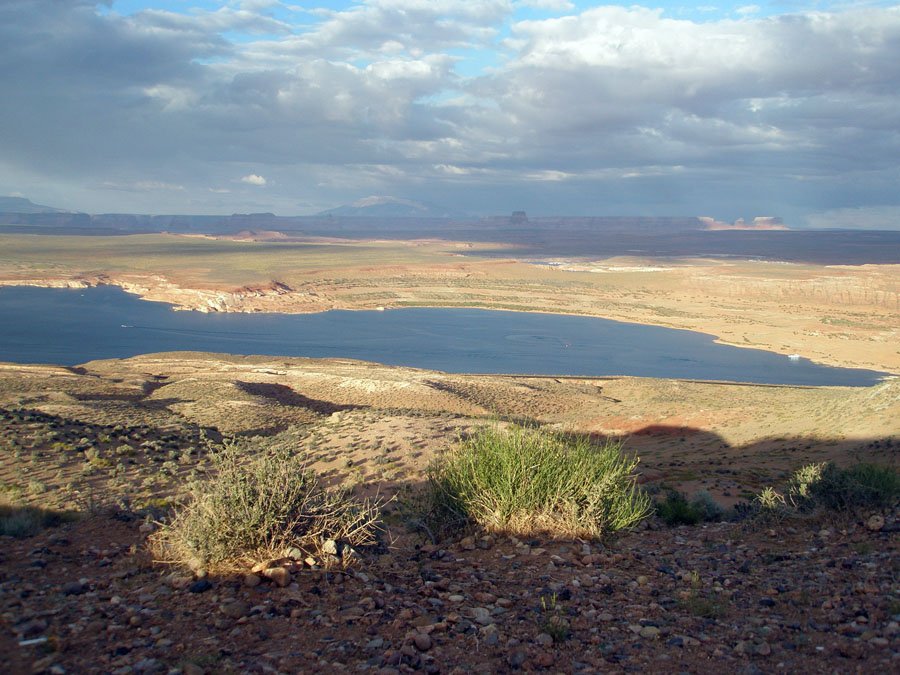
The Colorado River Basin provides an important setting for this work because water availability across the region is shaped by complex interactions among climate, snowpack, reservoirs, groundwater, land conditions, and human water use.
Improving the ability to interpret those interacting signals could ultimately support more informed forecasting and planning.
For EnviTrace, the project also builds on a broader area of focus: developing scientific AI tools that help experts work more effectively with incomplete, uncertain, and highly complex earth-system data.
A Collaborative Research Effort
EnviTrace is leading the RAIN project in collaboration with:
The project is part of the Department of Energy’s Genesis Mission, a national initiative aimed at accelerating scientific discovery by combining artificial intelligence with advanced computing, scientific data, and domain expertise.
EnviTrace was among a small group of privately owned companies selected to participate in the initiative.
The first phase of RAIN is intentionally focused and fast-moving, creating an opportunity to test whether these methods can improve understanding and prediction within real-world water systems.
From Santa Fe to a Regional Water Challenge
The Albuquerque Journal article also shares some of the history behind EnviTrace.
The company was founded in Santa Fe in 2021 by Trais Kliphuis and Velimir “Monty” Vesselinov, bringing together decades of experience in environmental programs, geoscience, subsurface modeling, artificial intelligence, and applied scientific research.
That combination continues to shape how EnviTrace approaches problems today.
Many of the most difficult environmental and energy decisions involve systems that are only partially observed. The available data may be incomplete, collected at different scales, or generated for different purposes.
The challenge is not simply collecting more data. It is extracting useful, defensible information from what is already available while being clear about what remains uncertain.
Water is a particularly important example.
As drought, changing hydrologic conditions, and growing demands place additional pressure on western water systems, better forecasting tools can help researchers and managers understand what may happen next — and why.
RAIN is one step toward that goal.
We appreciate Justin Horwath and the Albuquerque Journal for taking the time to highlight the project, the team behind it, and the larger water challenges motivating this work.
The article is also featured on GovTech: N.M. Company Aims to Use AI for Water, Flooding Predictions.